Artigo
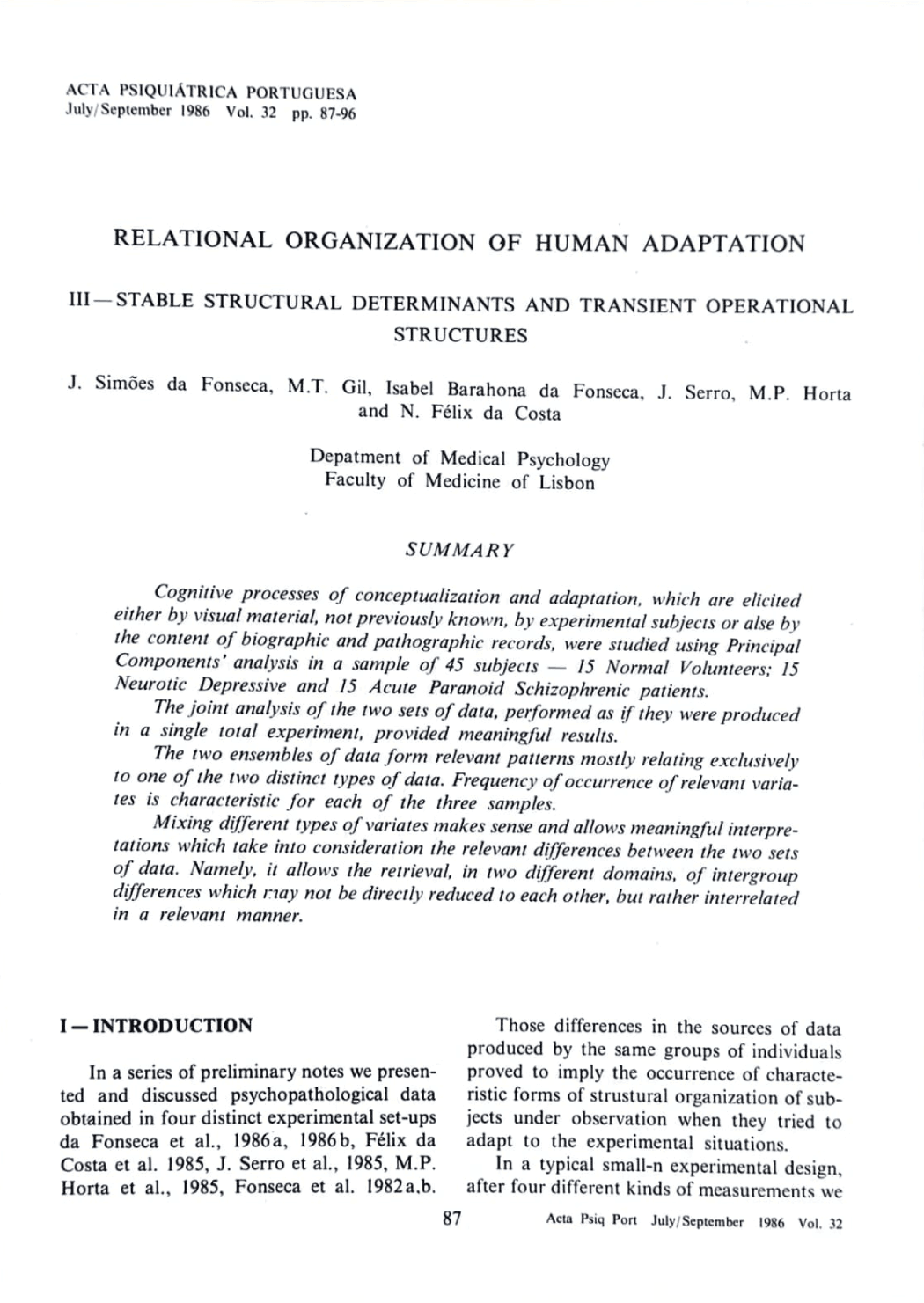
Relational organization of human adaptation — III. Stable structural determinants and transient operational structures
J. Simoes da Fonseca, M. T. Gil, Isabel Barahona da Fonseca, J. Serro, M. P. Horta, N. Felix da Costa
Acta Psiquiátrica Portuguesa, Julho/Setembro 1986, Vol. 32, n.º 3, pp. 87-96
Department of Medical Psychology, Faculty of Medicine of Lisbon
Summary
Cognitive processes of conceptualization and adaptation, which are elicited either by visual material, not previously known, by experimental subjects or else by the content of biographic and pathographic records, were studied using Principal Components' analysis in a sample of 45 subjects — 15 Normal Volunteers; 15 Neurotic Depressive and 15 Acute Paranoid Schizophrenic patients. The joint analysis of the two sets of data, performed as if they were produced in a single total experiment, provided meaningful results. The two ensembles of data form relevant patterns mostly relating exclusively to one of the two distinct types of data. Frequency of occurrence of relevant variates is characteristic for each of the three samples. Mixing different types of variates makes sense and allows meaningful interpretations which take into consideration the relevant differences between the two sets of data. Namely, it allows the retrieval, in two different domains, of intergroup differences which may not be directly reduced to each other, but rather interrelated in a relevant manner.
Páginas originais
A primeira página do artigo, tal como saiu impressa.