Artigo
Can a rating scale which aims to measure the relative loading in a set of general principles which influence decision-making and self-evaluation allow a retrieval of clinical diagnosis?
J. Simoes da Fonseca, J. Serro, M. P. Horta, N. Felix da Costa, I. Barahona Fonseca, E. Tomas
Acta Psiquiátrica Portuguesa, Outubro/Dezembro 1984, Vol. 30, n.º 4, pp. 93-99
Department of Medical Psychology, Faculty of Medicine of Lisbon
Summary
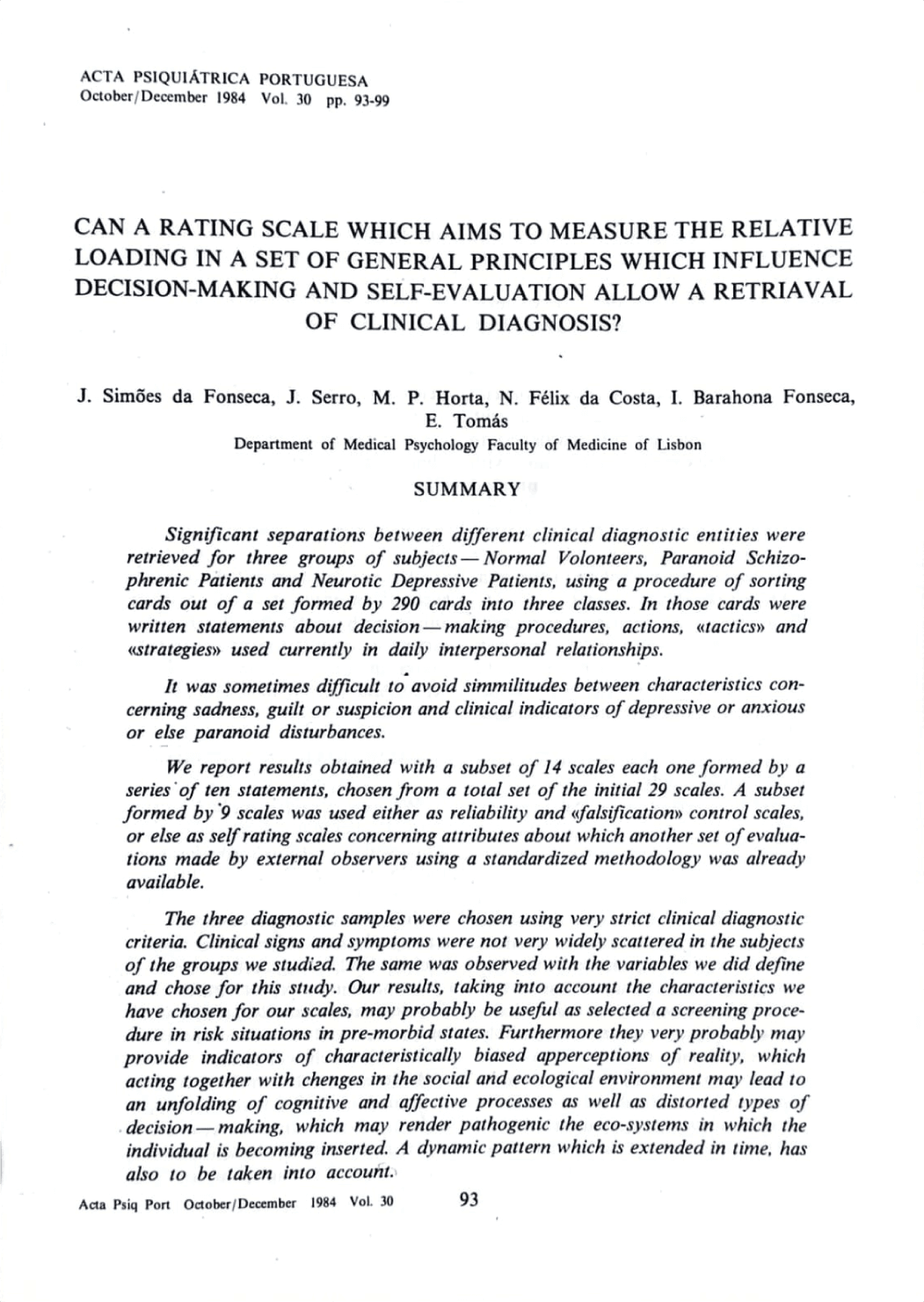
Significant separations between different clinical diagnostic entities were retrieved for three groups of subjects — Normal Volonteers, Paranoid Schizophrenic Patients and Neurotic Depressive Patients, using a procedure of sorting cards out of a set formed by 290 cards into three classes. In those cards were written statements about decision-making procedures, actions, «tactics» and «strategies» used currently in daily interpersonal relationships. It was sometimes difficult to avoid simmilitudes between characteristics concerning sadness, guilt or suspicion and clinical indicators of depressive or anxious or else paranoid disturbances. We report results obtained with a subset of 14 scales each one formed by a series of ten statements, chosen from a total set of the initial 29 scales. A subset formed by 9 scales was used either as reliability and «falsification» control scales, or else as self rating scales concerning attributes about which another set of evaluations made by external observers using a standardized methodology was already available. The three diagnostic samples were chosen using very strict clinical diagnostic criteria. Clinical signs and symptoms were not very widely scattered in the subjects of the groups we studied. The same was observed with the variables we did define and chose for this study. Our results, taking into account the characteristics we have chosen for our scales, may probably be useful as selected a screening procedure in risk situations in pre-morbid states. Furthermore they very probably may provide indicators of characteristically biased apperceptions of reality, which acting together with chenges in the social and ecological environment may lead to an unfolding of cognitive and affective processes as well as distorted types of decision-making, which may render pathogenic the eco-systems in which the individual is becoming inserted. A dynamic pattern which is extended in time, has also to be taken into account.
Páginas originais
A primeira página do artigo, tal como saiu impressa.